
Author: Salomé Wagner
#responsible AI – Europe’s Way to Success?
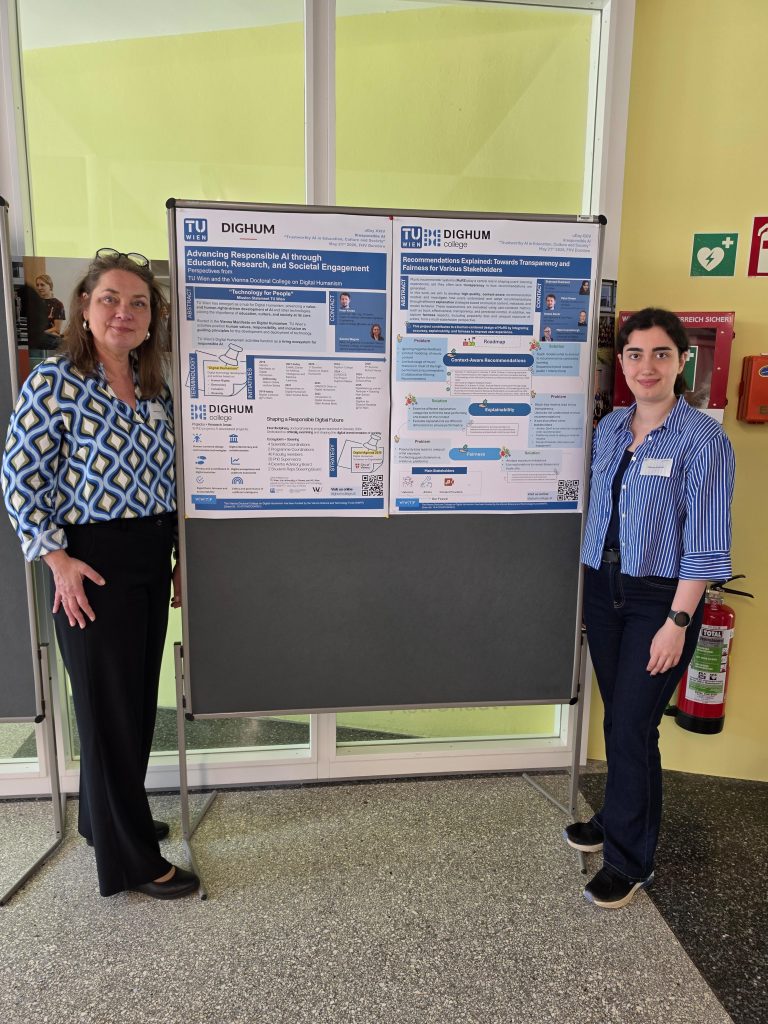
Poster Presentation at uDay XXIV, Conference at the Vorarlberg University of Applied Sciences on May 2026
How can Europe develop competitive AI systems while remaining aligned with democratic values, transparency, and human rights? These questions were at the core of the uDay XXIV conference. The discussions highlighted the importance of a dialogue between academia, industry, policymakers, and civil society. Responsible AI cannot emerge from isolated technical development alone. It requires collaboration across disciplines and institutions, as well as continuous public engagement.
Participating at the uDay XXIV conference, Shahrzad Shashaani and Salomé Wagner presented their projects on responsible AI, transparency, fairness, and interdisciplinary education. Their participation highlighted how Digital Humanism is becoming an essential framework for shaping trustworthy and human-centred artificial intelligence in Europe and around the globe.
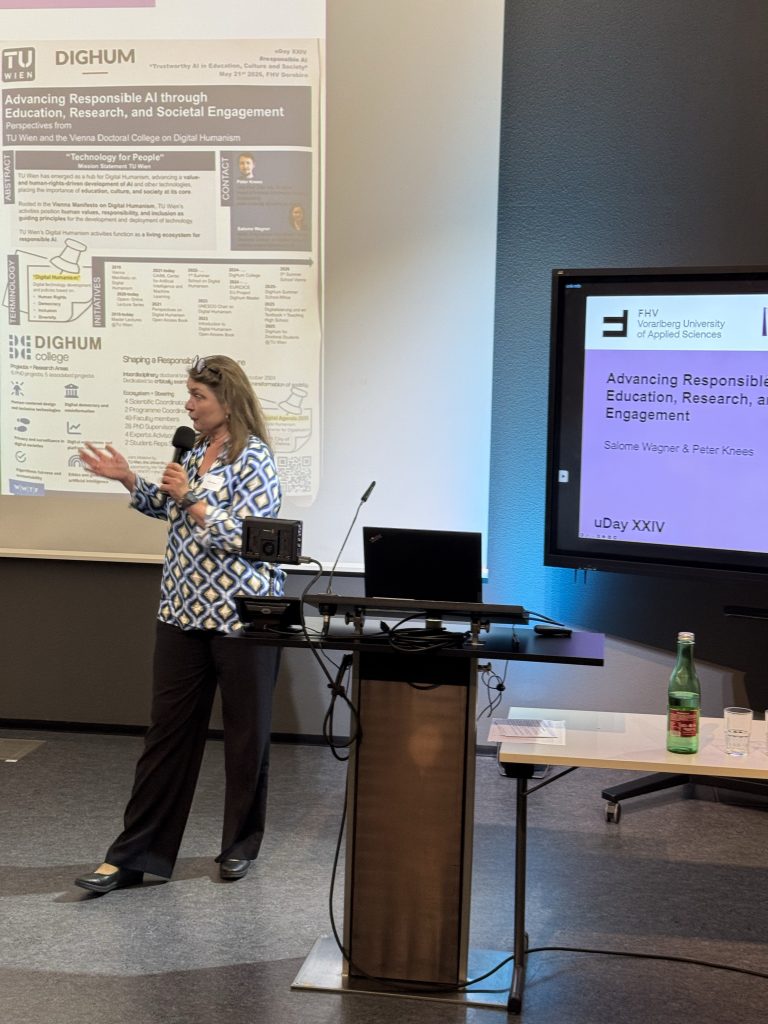
Salome Wagner presented the poster “Advancing Responsible AI through Education, Research and Societal Engagement,” focused on the broader Digital Humanism ecosystem at TU Wien and the Vienna Doctoral College on Digital Humanism as project thereof.
The poster outlined how TU Wien integrates responsible AI principles into education, interdisciplinary research, and societal engagement. Rooted in the Vienna Manifesto on Digital Humanism, the initiative promotes a value-driven approach to technological development centred on democracy, inclusion, diversity, and human rights.
The Vienna Doctoral College on Digital Humanism plays a central role in this mission. Established as a collaboration between TU Wien, the University of Vienna, and WU Vienna, funded by the WWTF (Vienna Science and Technology Fund), the college brings together researchers from computer science, law, social sciences, humanities, architecture, and economics.
Its objective is to educate a new generation of researchers capable of understanding both the technological and societal dimensions of digital transformation.
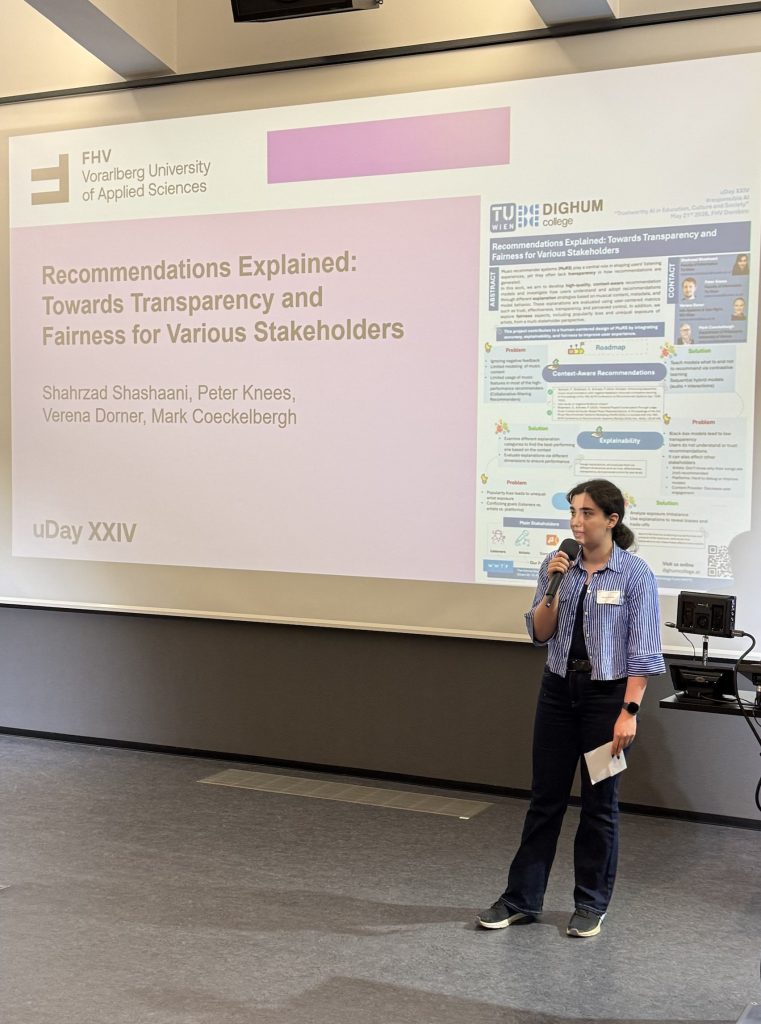
Shahrzad Shashaani, a PhD candidate of the Doctoral College, presented her project “Recommendations Explained: Towards Transparency and Fairness for Various Stakeholders”.
It explores how music recommender systems influence listening behaviour, artist visibility, and user trust. The research investigates explainability and fairness in AI-driven recommendation systems, focusing on how users understand and adopt algorithmic recommendations. Modern recommender systems often operate as “black boxes,” making decisions that shape cultural consumption without sufficient transparency.
The project addresses a central concern of Digital Humanism: technology should empower individuals rather than manipulate or obscure decision-making processes.
By studying explanation strategies based on musical content, metadata, listening context, and model behaviour, the researchers aim to improve transparency, trust, and user control.
At the same time, the project investigates fairness issues such as popularity bias, where already successful artists receive disproportionate visibility while lesser-known creators remain underrepresented.
LinkedIN Profile Sharzad Shashaani
LinkedIN Profile Salome Wagner