
Author: Salomé Wagner
Law, Regulation and Governance of Technology

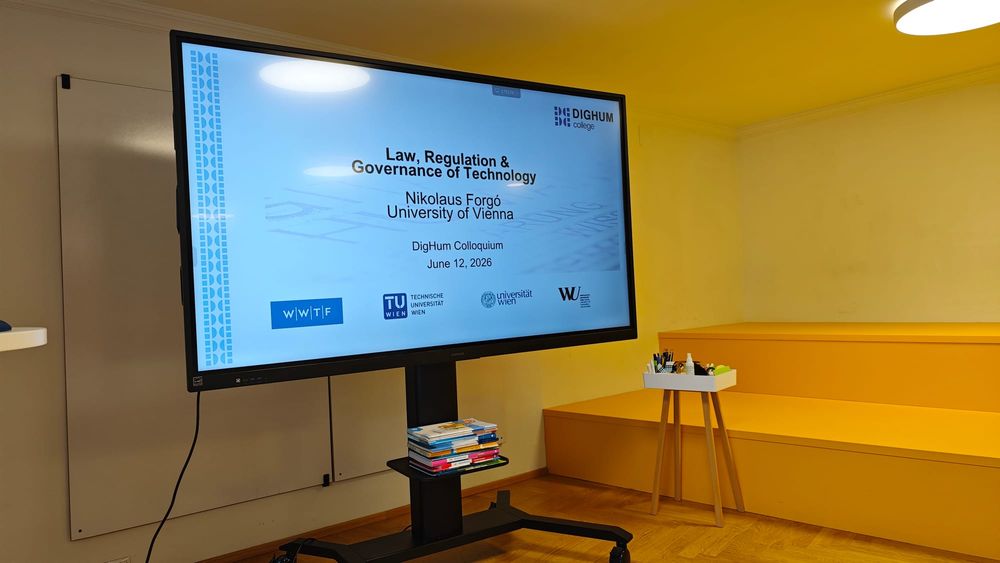
DigHum Colloquium with Prof. Nikolaus Forgó on June 12, 2026
Technology Regulations: about the balancing act between enabling innovation and protecting fundamental rights
In our June session Nikolaus Forgó from the University of Vienna explored one of the most pressing questions of our digital age: Law, Regulation and Governance of Technology. The discussion highlighted that technology regulation has always been a balancing act between enabling innovation and protecting fundamental rights. Today, with AI systems increasingly shaping decision-making, this balance has become more complex.

A central focus of the lecture was the European Union’s AI Act, the world’s first comprehensive regulatory framework for artificial intelligence. The AI Act follows a risk-based approach: the level of regulatory obligations depends on the probability and severity of potential harm. Certain AI applications are prohibited because they are considered to pose an unacceptable risk, while high-risk systems must comply with strict requirements regarding risk management, data governance, transparency, human oversight, accuracy, robustness, and cybersecurity.
The concept of Risk from different perspectives: Nikolaus made us look beyond the simple idea that “more regulation means more safety.”
The concept of risk itself is complex and depends not only on technological capabilities but also on societal values, political priorities, and our perception of uncertainty. The history of technology regulation demonstrates that fears about emerging technologies can influence legislation just as much as measurable risks.
Can trustworthy AI, based on transparency, accountability, and respect for human rights, become a strategic advantage for Europe?
The lecture also addressed the ongoing debate around whether European regulation could slow down technological competitiveness.
- Critics argue that extensive rules may discourage innovation and drive AI development elsewhere, particularly to the United States and Asia. Others emphasize that trustworthy AI, based on transparency, accountability, and respect for human rights, can become a strategic advantage for Europe.
- Another important point was the relationship between the AI Act and the broader European digital regulatory landscape.
AI governance does not exist in isolation but interacts with other legal frameworks, including data protection, cybersecurity, digital services, and digital markets regulation. This creates a complex ecosystem of overlapping responsibilities for technology providers, organizations, and regulators.
The discussion concluded with a broader reflection that lies at the heart of Digital Humanism: technology is never merely a technical question. It is a societal choice that requires legal, ethical, political, and interdisciplinary perspectives.
Nikolaus Forgo is a valued member of our faculty and Supervisor of the PhD project “Legal Frameworks vs. Technological Realities” (Candidate Julia Kalus).
LinkedIN Profile Nikolaus Forgo