Author: Salomé Wagner
“Navigating Urban Heat in Public Space”
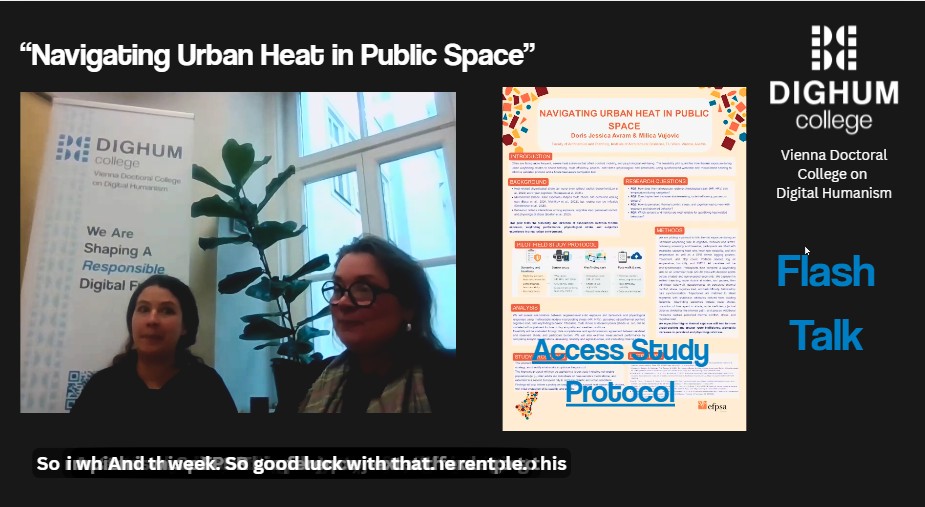
DigHum Flash Talk with Doris Avram
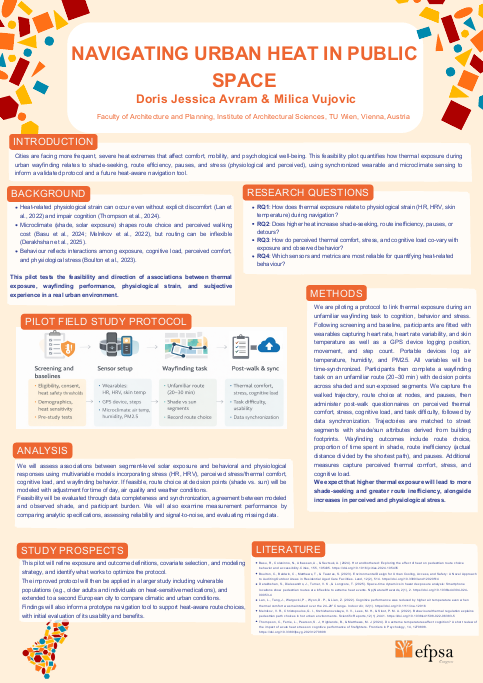
Poster Presentation at EFPSA Congress 2026: “Breaking Boundaries – Uniting Minds Across Borders and Disciplines”
At the 40th Congress of EFPSA 2026, Doris Avram from the Vienna Doctoral School on Digital Humanism presented her pilot study that bridges environmental science, human behavior, and digital innovation. Her research, “Navigating Urban Heat in Public Space,” examines how rising temperatures are reshaping the way people move through cities and how technology can support better adaptation.
In this interview, Doris explains how “Navigating Heat” as a research project is built and how to start with the pilot study coming up.
Cities across Europe are increasingly affected by extreme heat, turning everyday activities like walking into cognitively and physically demanding tasks. Avram’s work highlights a critical insight: heat influences not only comfort but also cognition, stress levels, and decision-making. Even without conscious discomfort, physiological signals such as heart rate and skin temperature can already indicate strain.
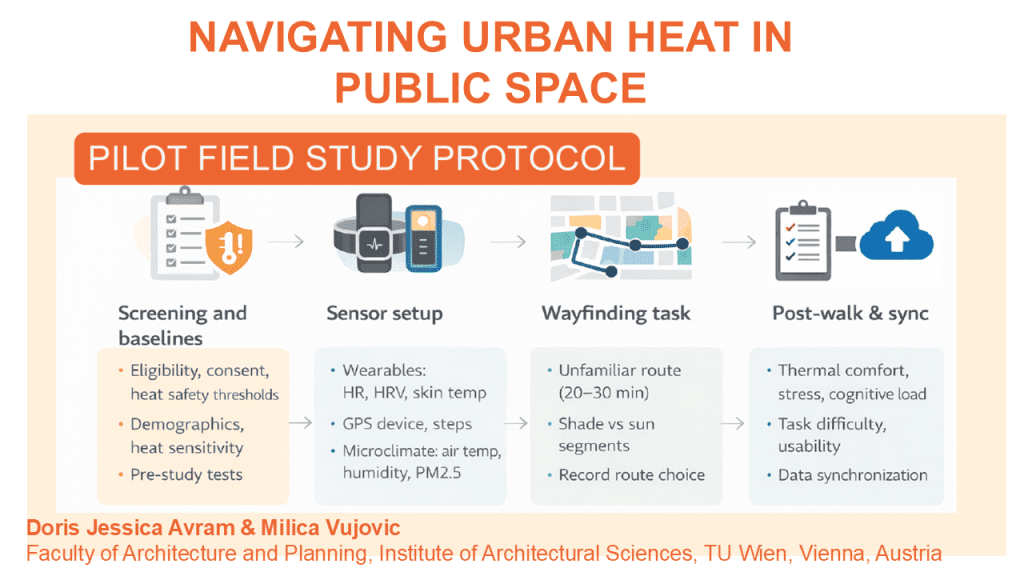
The study introduces an innovative field experiment combining wearable technology with environmental sensing. Participants are equipped with devices that track heart rate, heart rate variability, skin temperature, and movement, while portable sensors measure air temperature, humidity, and air quality. During a 20–30 minute wayfinding task in an unfamiliar urban setting, researchers observe how individuals navigate between shaded and sun-exposed areas.
What makes this approach particularly powerful is the synchronization of physiological, environmental, and behavioral data. This enables analysis of how thermal exposure affects route choices, pauses, efficiency, and perceived stress. The study expects that higher heat exposure leads to more shade-seeking behavior, less efficient navigation, and increased cognitive load.
Using an interdisciplinary approach that combines psychology, architecture, and computer science, the project aims to refine a methodology applicable to vulnerable groups, such as older adults. Ultimately, it will support the development of a “heat-aware” navigation tool that guides pedestrians along cooler, safer routes in real time.
Doris PhD project exemplifies digital humanism by placing human well-being at the center of technological innovation. It shows how data-driven insights can help create more livable, resilient cities.